Action at Achi Baba Nullah, 12-13 July 1915.

Action at Achi Baba Nullah, 12-13 July 1915.

“Peninsula, 12 July. Bombardment by our artillery on Turkish trenches commenced at 6.35 A.M. At 7.35 A.M the range of our artillery was lengthened and the Battn moved to the attack, passed over first and second trench and continued advancing with the object of occupying the Third trench. After advancing a distance of some 400 to 500 yds, Col. McNeile who commanded and was at the front leading the Battn, said to me, “We are too far forward, we must get back.” I replied “Very well Sir, I’ll stop the men and get them back.” No third trench was seen during the advance or when going back. Casualties were not very heavy during the advance, but when going back the Battn had to pass through the zone of fire of our own artillery, also the fire from the enemies artillery, machine guns and rifles, causing heavy losses. We then occupied part of the second Turkish trench which we commenced consolidating.”

– Unit War Diary of the 1/4th Kings Own Scottish Borderers, written by Major W.E A Cochrane.

As for those “heavy losses” the 1/4th KOSB suffered :

Officers Killed 5. Wounded 6. Missing 7. Total 18.

Other Ranks Killed 57. Wounded 203. Missing 275. Total 535.

Sir Ian Hamilton’s plan for a landing in another part of Gallipoli – Suvla – had now been prepared, but in order to give the Turks the impression that the main threat on Achi Baba still came fom Cape Helles, another attack in this area was planned. Hunter-Weston wanted one last crack at Achi Baba.

The 52nd Division, whose last brigade, the 157th, had just arrived on the peninsula, was the only division at Helles that was physically fit for offensive operations. Of that division, moreover, the 156th Bde had suffered abnormal casualties on the 28th June – so much so that four battalions had to form into two composite battalions – and the 155th and 157th Brigades were entirely new to active service operations.

The objective for the Allied attack on the 12th July was the enemy’s front system of trenches from the north-western bank of Kanli Dere on the left to the Rognon defences on the right. The frontage of attack was roughly a mile, of which 1,000 yards were allotted to the 52nd Division, and about 700 yards to the French. Opposite the British the depth of the enemy trench system varied from 200 to 400 yards. Roughly they seemed to consist of three main lines – front, support and reserve.

A marked and undoubtedly unfortunate feature of the British plan was that the 52nd Division’s attack was to be carried out in two halves. The right half would attack at 7.35 a.m and the left half nine hours later at 4.50 p.m. The reason for this was to enable all the available artillery to concentrate on each half of the objective in turn.

Egerton commanding the 52nd Division, detailed the 155th Brigade (1/4th & 1/5th Battalion, Royal Scots Fusiliers, and 1/4th & 1/5th Battalion, King’s Own Scottish Borderers) to carry out the morning assault, with the 157th Brigade (1/5th & 1/6th & 1/7th Battalion, Highland Light Infantry, and 1/5th Battalion, Argyll and Sutherland Highlanders) attacking in the afternoon. The 156th (formed by two composite battalions of 4/7th Royal Scots and 7/8th Cameronians) were to form the divisional reserve.

Both attacks were to be launched in four waves, one wave forming up in each of the four lines of trenches of which the British defensive system was then composed. All four waves were to advance simultaneously, straight over the top, without firing. The first two waves were to occupy a line which roughly corresponded to the enemy’s third or reserve line. The third wave was to hold the second or support line, and the fourth to remain in the enemy’s front line.

The next two points ensured that this assault was doomed to failure.

1) On July 10th a new aerial photgraph was taken which showed that on the front of the 157th Bde, the Turkish trench E12, which was known as the reserve line, wasn’t a trench at all. The map used in the planning of the operation were long out of date. New trench diagrams were now hastely made up, and copies sent to 52nd Division. At 7.30 on the eve of the battle Egerton was told that the revised objective for the 157th Brigade was trench E11. On the 155th front no change of plan was entailed.

These new orders reached divisional headquarters about 8p.m, but by some grave misfortune the battalions concerned never received them. The orders to the 157th Bde were not amended.

2) In order to prevent any maps or sketches falling into the enemy’s hands, stringent orders had been issued that all sketches, including diagrams of Turkish trenches, were to be destroyed or sent to the rear before the battle began. This unfortunate and indeed unnecessary order may explain the ommission to issue the new trench diagram, to troops in the line on the evening of the 11th . In any case, with all subordinate commanders trusting to their memories of, an inaccurate to begin with, maps and diagrams, it was unavoidable that in the heat of battle the assaulting waves should lose their bearings and be unable to send back an accurate indication of the various points reached. This was one more reason for the confusion that occurred in the course of the battle, and for the inability of divisional headquarters to keep the corps commander informed of the actual progress made.

Overall casualties of the action at Achi Baba Nullah were:

155th Brigade: Officers Killed 30, Wounded 18, Total 48

Other Ranks Killed 582, Wounded 673, Prisoners 13, Total 1268

156th Brigade: Officers Killed 2, Wounded 3, Total 5.

Other Ranks Killed 92, Wounded 129, Total 221.

157th Brigade: Officers Killed 29, Wounded 10, Total 39.

Other Ranks Killed 330, Wounded 608, Total 938.

Egerton was removed mid-battle that day. He would continue to complain and criticise his Corps Commander and would eventually be relieved of command. When he received the proofs of the 2nd volume of the Official History of the Gallipoli Operations, he returned them with some lengthy remarks, of which pertaining to the Battle of the 12th-13th July :

“It seems to me that the fighting of this battle was premature and at the actual moment worse than unnecessary – I submit that it was cruel and wasteful.

The troops on the Peninsula were tired and worn out; there were only two Infantry Brigades, the 155th and 157th that had not been seriously engaged. Both these Brigades were utterly new to war, and were at best second-line troops. One, the 157th, had only landed on the Peninsula eight days previously. Both had practically gone into the trenches straight from the beach. The remaining Brigade of the Division, the 156th, more than twice decimated on the 28th June, and reduced to two composite battalions, had within less than a week, such was the stress of circumstances, been sent into the trenches on July 6th to relieve the Indian troops.

It was well known to the higher Command that large reinforcements were arriving from England, and a grand attack was to be made at Suvla. Was it not therefore obvious that the exhausted garrison at Helles should be given a fortnight’s respite, and that the fresh attacks from that position should synchronise with those at Suvla and Anzac? It should by this time have been apparent that the Turk would not attack us – he never at any time did seriously counter-attack.

No. – I contend that the Battle of July 12-13th was due to a complete want of a true appreciation of the situation.

These ( the main tactics of the battle ) were entirely devised and directed by the 8th Corps. If, as I assert, the conception of the battle was wrong, the tactics of the action were far worse. The divisions of the attack of two Brigades on a narrow front into two phases, no less than nine hours apart, was positively wicked. The left, 157th Brigade, had been cooped up in narrow trenches for close on twenty four hours, exposed to the heat of a tropical sun since daybreak , and under continuous shell and rifle fire during the whole of that time. This was their initiation into their first fight in war. Further comment seems superfluous.”

Gallipoli, 1915 (Facebook)

Posted in History | Tagged , , , , , , | Leave a comment

The loss of the cruiser HMS Hampshire , with Lord Kitchener and his staff on board 5th June 1916.

The loss of the cruiser HMS Hampshire , with Lord Kitchener and his staff on board, on June 5th, 1916, has been one of the great mysteries of the war. The following narrative was given to the London correspondent of the ‘Manchester Guardian’ by a warrant officer who was saved from the wreck:-
HMS  Hampshire , four days after the Jutland battle, in which my informant said, she sunk a light cruiser and a submarine, took Lord Kitchener aboard on June 5th, 1916, about five in the evening, and set out with 800 souls in the foulest weather known in that region. She had two escorting destroyers, which soon returned to port, as they were unable to face the storm. Everything aboard was lashed down, and only one hatchway was open. My informant was on watch below.
At about eight o’ clock a terrible explosion took place forward, and there was a scramble for the companion. A large number of the crew were young and new hands, and there was a good deal of hurry. How my informant got on deck he did not know. When he got there the officers were at their posts, but their orders could not be heard owing to the fury of the storm and the escape of steam. There was no attempt to launch boats, which could never have lived on the sea that was running. The rafts were launched.
There was no sign of Lord Kitchener, and he thought that he probably never got on deck. (This differs from a report at the time of Lord Kitchener having been seen on deck.) There was not five minutes between the explosions and the disappearance of the ship. He had tried and failed to open other hatchways, and he thinks that the crowd at the single one at which he emerged may have blocked many people from getting on deck.
The raft drifted before the gale for five hours, and of the 80 on the raft many had been washed off, and of the rest all but four had died and had fallen into the net in the middle of the raft. On reaching shore my informant scrambled out, and found himself among the rocks, and eventually with one other man for to the top about half-past four in the morning. There he found a shed, and he spied a moving light. His companion went after it, and found a farmer going about in search of cattle. With the aid of some farm folk, the four survivors, who had been taken to the farmhouse, were well looked after. In all there were twelve survivors, two on a second and six on a third raft, blown ashore two or three miles from his landing place. No officers were saved, a fact which incidentally, the warrant officer said, prevented their doings at the Jutland battle from being reported and rewarded.
My informant utterly scoffed at the idea of Lord Kitchener being alive. He was quite sure that the Hampshire was not torpedoed, but mined. [Hull Daily Mail, Friday, 27 December 1918]

2

About 7.35 pm on June 6, 1916, the British armoured cruiser Hampshire with Lord Kitchener on board, on his way home from Scapa to Russia, struck a mine off the Brough of Birsay, west of the main island in the Orkneys, and went down in fifteen minutes in a terrific sea. Only 12 men survived the disaster, in which Lord Kitchener, his staff, and all the officers on board perished. Wild tales of treachery were current at the time and afterwards, but the facts exclude any such possibility. The field of twenty-two mines in which the  Hampshire sank was laid by U75 (Lieut-Commander C Beitzen) in the swept channel to the west of the Orkneys, on May 29, as part of the operations planned by Scheer which issued in the battle of Jutland. On the say of Lord Kitchener’s departure a great gale was raging with mountainous seas breaking from the north-east. He himself insisted on the importance of leaving at once without any delay, and Jellicoe yielded to his wishes, though with reluctance.
The original intention had been that the Hampshire should take the easterly route from Scapa Flow; but as with the gale it was impossible to sweep the channel on that side, and escorting destroyers could not accompany the ship, the final decision was to send the HAPSIRE by the western route, where she would be better sheltered. Eben so there were two possible courses, by Sule Skerry, that lonely light thirty miles west of Orkney set in a raging sea, or close under the Orkney coast. The second route was chosen because it was the more sheltered, and, further, it had been under constant observation and was much used by auxiliaries.
At 5.30 pm the  Hampshire  steamed out of Scapa convoyed by two destroyers, UNITY and VICTOR. Shortly after she left, the wind shifted to a fifty-mile gale from the north-west, and they were quite unable to keep up with her in the sea that was running. Even if they had been there in that storm with the intense coldness of the water it is doubtful whether they could have effected much. When the ship was mined discipline was faithfully maintained to the end, though in the gale boats could not be lowered. Only twelve men reached the iron coast of the Orkneys alive, Kitchener was seen on deck, collected and calm; and thus this great servant of England passed from earth.
Two accidents brought about the loss of his life and the death of 700 officers and men; the storm which prevented the usual route from being followed and the shift of the wind which prevented destroyers from accompanying the Hampshire on her westward route. If Kitchener’s intended journey to Russia had ben betrayed, no one could have counted on these mischances. [Battleships in Action: Wilson]

The last photograph of Lord Kitchener before he drowned along with 655 crewmen and 7 passengers aboard HMS Hampshire.

Posted in History | Tagged , , , , , , , , | Leave a comment

Disguised German Warship “Aud” sunk while trying to land arms on Irish coast.

Disguised German Warship “Aud” sunk while trying to land arms on Irish coast.

For the first time since the German gun-running ship ‘The Aud’ was scuttled in April 1916, an Irish underwater archaeological team captured footage of the wreckage lying on the bottom of Cork Harbour.

The Aud, formerly the SS Libau was originally a steam cargo transport built for the Wilson Line of Hull in England in 1907. When World War One broke out it was known as the SS Castro for the Wilson shipping company and was captured by the German navy in the Keil Canal. The vessel was subsequently disguised as a Norwegian steamer the Aud to transport 20,000 rifles, one million rounds of ammunition and three machine guns for the planned Easter Rising of 1916.  

The Aud arrived off the Kerry coast on 20 April 1916 but due to communication problems, it was unsuccessful in landing the cargo in Fenit Harbour as planned. The Aud had been tracked by the Royal Navy for the entire journey to Ireland. The ship was intercepted by the British and taken to Cork Harbour where on 22 April 1916, the captain of the vessel Karl Spindler scuttled the ship six rather than have it fall into enemy hands.

Kate Lynch was fourteen years old when the Aud tried to land a cargo of arms she recalls the events at Fenit. 

Meanwhile Sir Roger Casement, who had negotiated the arms shipment with Germany, arrived by German U-Boat to Banna Strand expecting to meet  the Aud. He was subsequently arrested, tried for treason and executed on 3 August 1916.

For the first time since 1916, the wreck of the Aud is being inspected by members of the National Monuments Service diving unit and a 12 member team from the Irish Underwater Archaeological Research Trust (IUART). Colin Breen National Monuments Office says their aim is to

Look at the wreck on the seabed, to try and assess its state, to try and see if it is undergoing active erosion, and to see if we can actually do anything to stop that erosion, and to protect the site in situ on the seabed.

IUART projects officer Andre Thoma explains their task is difficult as the divers can only spend 12 minutes at a time down at the wreck before having to resurface. He describes some of the team’s discoveries noting

The seabed is still littered with ammunition.

He explains that bombing and depth charging by the British during World War Two and natural erosion have taken a toll on the wreck.

But for a ship that has gone through all that, it is still actually quite intact.

This episode of ‘Nationwide’ was broadcast on 15 August 1997. The reporter is Tom MacSweeney.

RTE Archives.

Posted in History | Leave a comment

HMS Irresistible and HMS Ocean Sunk.18th March 1915.

HMS IRRESISTIBLE; British Navy, 1st class battleship; 1902; Chatham Dockyard; 15,000 tons; 430x75x29 ft; 15.000 i.h.p.; 18.5 kn.; triple expansion engine and Belleville boilers; 4 x 12 in. guns, 12 x 6 in. guns, 16 x 12pdr., 6 x 3pdr., 2 mg , 4 T.T.

The HMS Irresistible (Capt. D. L. Dent ) carried a complement of 780, when on the 18th March 1915, she was engaged in the bombardment of the forts of the Dardanelles. She was struck by a shell from the Turkish and a loud explosion caused the ship to list. Uncontrollable, she started drifting and struck a mine which exploded next to the engine room, flooding it and drowning nearly all inside. The Irresistible now became an easy target for the Turkish-German enemy, but destroyer HMS Wear and the battleship HMS Ocean came to her assistance. Under continuous fire, HMS Wear managed to embark 28 officers and 582 ratings and HMS Ocean now tried to take Irresistible in tow, but this was abandonned due to intense fire from the enemy.

Later in the night, the British tried to move Irresistible to safety, but while doing so, HMS Ocean was also mined. Both ships sank during the night but nearly all the crews of both ships were saved. Read more at wrecksite: https://wrecksite.eu/wreck.aspx?99790

Jan Lettens

ref. used:Hocking, Charles, Dictionary of Disasters at Sea during the Age of Steam

Posted in History | Leave a comment

Zeppelin crashes into the North Sea 2nd Feb 1916.

Two days after nine German zeppelins dropped close to 400 bombs throughout the English Midlands, the crew of the British fishing trawler King Stephen comes across the crashed remains of one of the giant airships floating in the North Sea.

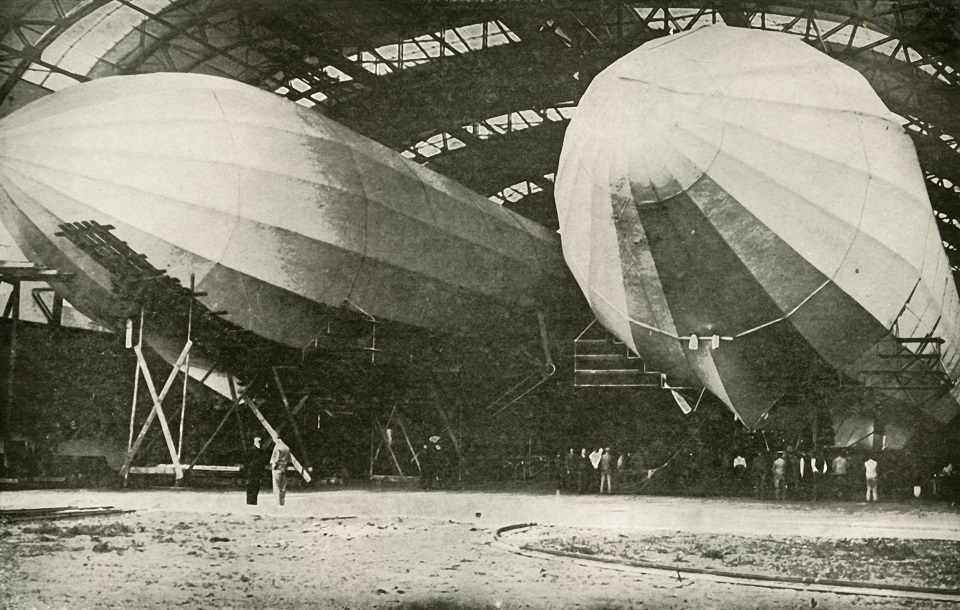
Developed by a German army officer, Count Ferdinand Zeppelin, and first flown in 1900, the zeppelin was an impressive aircraft by the beginning of WW1 With the capacity to carry five machine guns and up to 2,000 kilograms (4,400 pounds) of bombs, it could reach a maximum speed of 136 kilometers per hour (84.5 miles per hour) and a height of 4,250 meters (13,943 feet).

The first zeppelin attack on England took place on January 19, 1915, when two of the airships bombed the English coastal towns of Great Yarmouth and King’s Lynn, killing a total of four people. The first bombing raid on London came on May 31 of that year, when a single zeppelin dropped 90 small bombs and 30 grenades on the city, leaving seven dead and 35 wounded.

The raid of January 31, 1916, by nine zeppelins was one of the largest Britain saw during the war. The Germans bombed the West Midlands towns of Bradley, Tipton, Wednesbury and Walsall. Across the region, more than 70 people were killed and more than 100 injured in the attacks.

Just before daybreak on February 2, King Stephen skipper William Martin spotted a downed airship partially submerged in the North Sea. The skipper and his crew waited at a safe distance until daylight when they confirmed the wreckage was that of a German zeppelin with the identification mark L-19. With three of its four engines failing, the L-19 had reportedly come under Dutch fire, which punctured its gas cells and brought it down, killing some of the crew.

The nine unarmed men aboard the King Stephen saw that about 20 German soldiers had survived the crash. Fearful that the German airmen could easily overpower them and take control of the ship, Martin and his crew refused the soldiers’ pleas for help and did not take the men aboard, choosing instead to return to Britain to report their discovery to the authorities. The remaining crew of the L-19 disappeared with their craft. Word of the incident soon got out in both Germany and Britain–some saw Martin’s decision as a necessary one to protect his crew, while others, including some Britons, vilified Martin for what they saw as an unpardonable act of cruelty, even for wartime.

Image

HistCom.

Posted in History | Tagged , , , , , , , | Leave a comment

German Zeppelins Were Made with Cow Intestines And It led to sausage restrictions during WWI.

The
The “Zeppelins” were an important factor in the German principle of “frightfulness.” (Photo by The Print Collector/The Print Collector/Getty Images)

A rain of German bombs falling onto London may sound like a scene from the Blitz, but the city was also attacked by Germany during WWI, not by sleek metal-skinned aircraft, but by Zeppelins. Described by Winston Churchill as “enormous bladders of combustible gas,” these ominous lighter-than-air crafts caused 500 deaths in Britain. They also caused chaos on their own people, by denying them of their beloved sausages.

Although there was little evidence that airships were suited to military environments (they weren’t, by the way), there was a great demand for them among the German top brass. The ships could carry far more bombs over a further distance than aircraft, all while mounting defensive machine guns and they were actually quite hard to bring down.

However, unsurprisingly, the airships were still vulnerable to a prepared enemy and proved to be unwieldy, struggling to effectively navigate precisely over targets and lacking accurate bombing techniques.

Even when moored up the airships were thrown around by strong winds, and a few were lost because of poor weather conditions.

The airships had a powerful psychological effect but proved to be a rather lackluster weapon of war, and their use was eventually abandoned.

Beefy machines

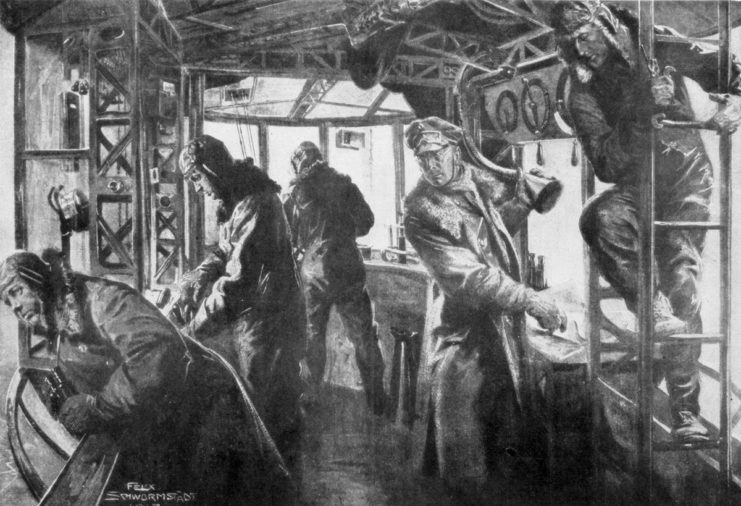
Zeppelin Command Center
‘Command area onboard a Zeppelin’, German air fleet, First World War, 1917. (Photo by The Print Collector/Print Collector/Getty Images)

These gigantic machines could measure up to 240 meters in length and required immense resources to construct. One of the most important was cow guts. The cow guts were used to make the bags that contained the airship’s gas. The gas is what makes the airships lighter than air.

Because the airships were huge, the number of resources they used was huge too, with each German Zeppelin using around 250,000 cows.

The same material used for the gasbags is also used to make sausages, albeit in a much more precise process. The German authorities were forced to choose between sausages or their airships. As we now know, airships won this logistical tug of war, with the resources once used to make sausages instead being diverted to Zeppelin construction.

An airship could use up to 30 million potential sausages.

During this drive for airship construction, the production of sausages was outlawed in Germany and other occupied territories.

Goldbeater’s skin

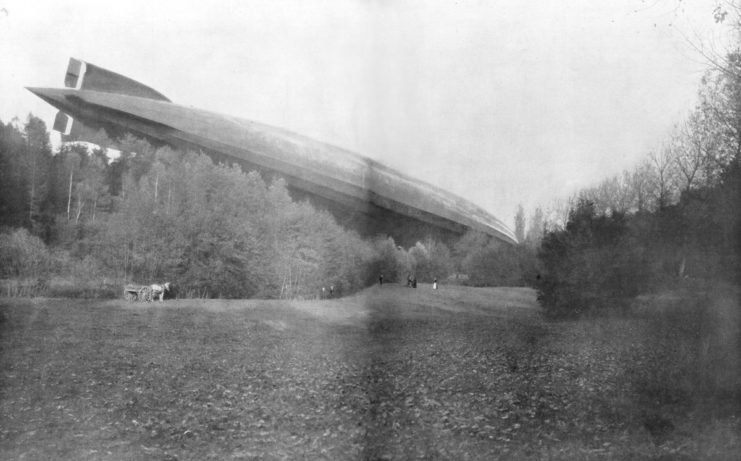
Zeppelin Shot Down
German Zeppelin L49 brought down and captured intact by the French, 20 October 1917. (Photo by The Print Collector/Print Collector/Getty Images)

The intestinal skin, also known as goldbeater’s skin, is incredibly resistant to tearing yet very thin and light. It has been used for many different things over the centuries but got its name from its use in the production of gold leaf. The skin is placed between layers of gold during gold beating, a process that can thin out many layers of gold separately.

1922 report on balloon fabrics for the US National Advisory Committee for Aeronautics highlights how valuable these guts were.

“The collection of the goldbeater’s skins was very systematic in Germany during the war,” the document reads. “Each butcher was required to deliver the ones from the animals he killed. Agents exercised strict control in Austria, Poland and northern France, where it was forbidden to make sausages.”

The intestines normally used to make sausages were wetted, separated, and had the outer membrane peeled away. It was then washed in an alkaline solution and stretched dry. The resulting material is goldbeater’s skin; exceptionally thing, yet strong.

The Germans experimented with other materials to build the gas bags, like rubber, but they were unable to find a way of sealing the bags enough to stop hydrogen, the lightest element in the universe, from escaping.

However, they realized that if layers of goldbeater’s skin were laid on top of each other when wet, they fuse together as they dry. This creates a material that, according to the 1922 report, “for a weight of 130 to 150 g per sq. m, a tightness permitting the loss of only a few liters of hydrogen per sq. m in 24 hours, under a pressure of 30 mm of water.”

As a result, Germany went without sausages in the name of strategic bombing.

Jesse Beckett is one of the authors writing for WAR HISTORY ONLINE

Posted in History | Tagged , , , , , , , | Leave a comment

SS Artist torpedoed January 27th 1917.

The Secretary of the Admiralty makes the following announcement:-

The British steamship ARTIST (1917), when 48 miles from land, in a heavy easterly gale, was torpedoed by a German submarine on Saturday morning. In response to her appeal, sent by wireless, “SOS, sinking quickly,” auxiliary patrol craft proceeded to the spot, and searched the vicinity, but found no trace of the vessel or her survivors.

Three days later the steamship LUCHANA picked up a boat containing 16 of the survivors. The boat had originally contained 23, but seven had died of wounds and exposure, and were buried at sea.

The surviving 16 were landed, and of these 5 were suffering from severe frostbite, and one from e broken arm. The crew had been forced to abandon their ship in open boats in a midwinter gale, and utterly without means of reaching land or succour.

Those of them who perished during three days of bitter exposure were murdered, and to pretend that anything was done to ensure their safety would be sheer hypocrisy. The pledge given by Germany to the United States not to sink merchant ships without ensuring the safety of the passengers and crews have been broken before, abut never in circumstances of more cold-blooded brutality.

[Aberdeen Journal 1.2.1917]

There were a few survivors who were picked up after two nights and three days in an open lifeboat including a young cadet officer Robert Davies Owen aged 18. He spent several months recovering from the affects of hypothermia and exposure. He went on to study medicine at Guy’s Hospital in London before becoming a leading Ear Nose and Throat surgeon at Cardiff Royal Infirmary. He died in 1990

Simon Theakston

ARTIST was a 3.570grt, defensively-armed British Merchant Ship. On the 27th January 1917 when 58 miles W ½ S from the Smalls, South Wales she was torpedoed without warning and sunk by a submarine. 35 lives lost including Master.

Tony Allen

Posted in History | Tagged , , , , , , , , , | Leave a comment

The HMS Bulwark Explosion 26th Nov 1914.

On 26th November 1914 HMS Bulwark, a 15,000 ton battleship, was moored at buoy number 17 at Kethole Reach on the River Medway. She was taking on coal from the airship base at Kingsnorth, on the Isle of Grain.

At 7.50am, as the crew were having breakfast, an explosion ripped the ship apart. The explosion was heard as far away as Whitstable to the south and Southend (in Essex) to the North. Eye witnesses stated that once the smoke has cleared, there was no sign of the ship. This evidence is supported by the fact that naval divers who investigated the wreck three days after the explosion found just two large fragments of wreckage – a section of the port bow as far aft as the sick bay, and 30 feet further away, a section of the starboard bow. Debris from the explosion fell up to four miles away.

In all, the explosion killed 745 men and 51 officers. Five of the 14 men who survived died later of their wounds, and almost all of the others were seriously wounded. There are mass and individual graves in Woodlands Cemetery in Gillingham, for the Bulwark’s dead, who were mostly drawn from the Portsmouth area.

Although the local papers immediately suspected sabotage, the subsequent naval court of enquiry (held at the Royal Naval Hospital at Gillingham found that much of the ammunition for the ships guns had been stored in the corridors between the 11 magazines, and that either a fault with one of the shells or overheating cordite near a boiler room bulkhead could have started a chain reaction which destroyed the ship.

Image

The site of the wreck is now a restricted area, designated as a Military Wreck by the Admiralty, and is marked by two buoys the East Bulwark (Green Conical at 51. 25. 21. 25 N, 00. 39. 13. 78 E) and West Bulwark (Red Can at 51. 25. 23. 25 N, 00. 39. 13. 78.E).

Posted in History | Tagged , , , , , | Leave a comment

Action at Achi Baba Nullah, 12-13 July 1915.

Action at Achi Baba Nullah, 12-13 July 1915.

Action at Achi Baba Nullah, 12-13 July 1915.

“Peninsula, 12 July. Bombardment by our artillery on Turkish trenches commenced at 6.35 A.M. At 7.35 A.M the range of our artillery was lengthened and the Battn moved to the attack, passed over first and second trench and continued advancing with the object of occupying the Third trench. After advancing a distance of some 400 to 500 yds, Col. McNeile who commanded and was at the front leading the Battn, said to me, “We are too far forward, we must get back.” I replied “Very well Sir, I’ll stop the men and get them back.” No third trench was seen during the advance or when going back. Casualties were not very heavy during the advance, but when going back the Battn had to pass through the zone of fire of our own artillery, also the fire from the enemies artillery, machine guns and rifles, causing heavy losses. We then occupied part of the second Turkish trench which we commenced consolidating.”

– Unit War Diary of the 1/4th Kings Own Scottish Borderers, written by Major W.E A Cochrane.

As for those “heavy losses” the 1/4th KOSB suffered :

Officers Killed 5. Wounded 6. Missing 7. Total 18.

Other Ranks Killed 57. Wounded 203. Missing 275. Total 535.

Sir Ian Hamilton’s plan for a landing in another part of Gallipoli – Suvla – had now been prepared, but in order to give the Turks the impression that the main threat on Achi Baba still came fom Cape Helles, another attack in this area was planned. Hunter-Weston wanted one last crack at Achi Baba.

The 52nd Division, whose last brigade, the 157th, had just arrived on the peninsula, was the only division at Helles that was physically fit for offensive operations. Of that division, moreover, the 156th Bde had suffered abnormal casualties on the 28th June – so much so that four battalions had to form into two composite battalions – and the 155th and 157th Brigades were entirely new to active service operations.

The objective for the Allied attack on the 12th July was the enemy’s front system of trenches from the north-western bank of Kanli Dere on the left to the Rognon defences on the right. The frontage of attack was roughly a mile, of which 1,000 yards were allotted to the 52nd Division, and about 700 yards to the French. Opposite the British the depth of the enemy trench system varied from 200 to 400 yards. Roughly they seemed to consist of three main lines – front, support and reserve.

A marked and undoubtedly unfortunate feature of the British plan was that the 52nd Division’s attack was to be carried out in two halves. The right half would attack at 7.35 a.m and the left half nine hours later at 4.50 p.m. The reason for this was to enable all the available artillery to concentrate on each half of the objective in turn.

Egerton commanding the 52nd Division, detailed the 155th Brigade (1/4th & 1/5th Battalion, Royal Scots Fusiliers, and 1/4th & 1/5th Battalion, King’s Own Scottish Borderers) to carry out the morning assault, with the 157th Brigade (1/5th & 1/6th & 1/7th Battalion, Highland Light Infantry, and 1/5th Battalion, Argyll and Sutherland Highlanders) attacking in the afternoon. The 156th (formed by two composite battalions of 4/7th Royal Scots and 7/8th Cameronians) were to form the divisional reserve.

Both attacks were to be launched in four waves, one wave forming up in each of the four lines of trenches of which the British defensive system was then composed. All four waves were to advance simultaneously, straight over the top, without firing. The first two waves were to occupy a line which roughly corresponded to the enemy’s third or reserve line. The third wave was to hold the second or support line, and the fourth to remain in the enemy’s front line.

The next two points ensured that this assault was doomed to failure.

1) On July 10th a new aerial photgraph was taken which showed that on the front of the 157th Bde, the Turkish trench E12, which was known as the reserve line, wasn’t a trench at all. The map used in the planning of the operation were long out of date. New trench diagrams were now hastely made up, and copies sent to 52nd Division. At 7.30 on the eve of the battle Egerton was told that the revised objective for the 157th Brigade was trench E11. On the 155th front no change of plan was entailed.

These new orders reached divisional headquarters about 8p.m, but by some grave misfortune the battalions concerned never received them. The orders to the 157th Bde were not amended.

2) In order to prevent any maps or sketches falling into the enemy’s hands, stringent orders had been issued that all sketches, including diagrams of Turkish trenches, were to be destroyed or sent to the rear before the battle began. This unfortunate and indeed unnecessary order may explain the ommission to issue the new trench diagram, to troops in the line on the evening of the 11th . In any case, with all subordinate commanders trusting to their memories of, an inaccurate to begin with, maps and diagrams, it was unavoidable that in the heat of battle the assaulting waves should lose their bearings and be unable to send back an accurate indication of the various points reached. This was one more reason for the confusion that occurred in the course of the battle, and for the inability of divisional headquarters to keep the corps commander informed of the actual progress made.

Overall casualties of the action at Achi Baba Nullah were:

155th Brigade: Officers Killed 30, Wounded 18, Total 48

Other Ranks Killed 582, Wounded 673, Prisoners 13, Total 1268

156th Brigade: Officers Killed 2, Wounded 3, Total 5.

Other Ranks Killed 92, Wounded 129, Total 221.

157th Brigade: Officers Killed 29, Wounded 10, Total 39.

Other Ranks Killed 330, Wounded 608, Total 938.

Egerton was removed mid-battle that day. He would continue to complain and criticise his Corps Commander and would eventually be relieved of command. When he received the proofs of the 2nd volume of the Official History of the Gallipoli Operations, he returned them with some lengthy remarks, of which pertaining to the Battle of the 12th-13th July :

“It seems to me that the fighting of this battle was premature and at the actual moment worse than unnecessary – I submit that it was cruel and wasteful.

The troops on the Peninsula were tired and worn out; there were only two Infantry Brigades, the 155th and 157th that had not been seriously engaged. Both these Brigades were utterly new to war, and were at best second-line troops. One, the 157th, had only landed on the Peninsula eight days previously. Both had practically gone into the trenches straight from the beach. The remaining Brigade of the Division, the 156th, more than twice decimated on the 28th June, and reduced to two composite battalions, had within less than a week, such was the stress of circumstances, been sent into the trenches on July 6th to relieve the Indian troops.

It was well known to the higher Command that large reinforcements were arriving from England, and a grand attack was to be made at Suvla. Was it not therefore obvious that the exhausted garrison at Helles should be given a fortnight’s respite, and that the fresh attacks from that position should synchronise with those at Suvla and Anzac? It should by this time have been apparent that the Turk would not attack us – he never at any time did seriously counter-attack.

No. – I contend that the Battle of July 12-13th was due to a complete want of a true appreciation of the situation.

These ( the main tactics of the battle ) were entirely devised and directed by the 8th Corps. If, as I assert, the conception of the battle was wrong, the tactics of the action were far worse. The divisions of the attack of two Brigades on a narrow front into two phases, no less than nine hours apart, was positively wicked. The left, 157th Brigade, had been cooped up in narrow trenches for close on twenty four hours, exposed to the heat of a tropical sun since daybreak , and under continuous shell and rifle fire during the whole of that time. This was their initiation into their first fight in war. Further comment seems superfluous.”

Gallipoli, 1915 (Facebook)

Posted in History | Tagged , , , , , , | Leave a comment

The loss of the cruiser HMS Hampshire , with Lord Kitchener and his staff on board 5th June 1916.

The loss of the cruiser HMS Hampshire , with Lord Kitchener and his staff on board, on June 5th, 1916, has been one of the great mysteries of the war. The following narrative was given to the London correspondent of the ‘Manchester Guardian’ by a warrant officer who was saved from the wreck:-
HMS  Hampshire , four days after the Jutland battle, in which my informant said, she sunk a light cruiser and a submarine, took Lord Kitchener aboard on June 5th, 1916, about five in the evening, and set out with 800 souls in the foulest weather known in that region. She had two escorting destroyers, which soon returned to port, as they were unable to face the storm. Everything aboard was lashed down, and only one hatchway was open. My informant was on watch below.
At about eight o’ clock a terrible explosion took place forward, and there was a scramble for the companion. A large number of the crew were young and new hands, and there was a good deal of hurry. How my informant got on deck he did not know. When he got there the officers were at their posts, but their orders could not be heard owing to the fury of the storm and the escape of steam. There was no attempt to launch boats, which could never have lived on the sea that was running. The rafts were launched.
There was no sign of Lord Kitchener, and he thought that he probably never got on deck. (This differs from a report at the time of Lord Kitchener having been seen on deck.) There was not five minutes between the explosions and the disappearance of the ship. He had tried and failed to open other hatchways, and he thinks that the crowd at the single one at which he emerged may have blocked many people from getting on deck.
The raft drifted before the gale for five hours, and of the 80 on the raft many had been washed off, and of the rest all but four had died and had fallen into the net in the middle of the raft. On reaching shore my informant scrambled out, and found himself among the rocks, and eventually with one other man for to the top about half-past four in the morning. There he found a shed, and he spied a moving light. His companion went after it, and found a farmer going about in search of cattle. With the aid of some farm folk, the four survivors, who had been taken to the farmhouse, were well looked after. In all there were twelve survivors, two on a second and six on a third raft, blown ashore two or three miles from his landing place. No officers were saved, a fact which incidentally, the warrant officer said, prevented their doings at the Jutland battle from being reported and rewarded.
My informant utterly scoffed at the idea of Lord Kitchener being alive. He was quite sure that the Hampshire was not torpedoed, but mined. [Hull Daily Mail, Friday, 27 December 1918]

2

About 7.35 pm on June 6, 1916, the British armoured cruiser Hampshire with Lord Kitchener on board, on his way home from Scapa to Russia, struck a mine off the Brough of Birsay, west of the main island in the Orkneys, and went down in fifteen minutes in a terrific sea. Only 12 men survived the disaster, in which Lord Kitchener, his staff, and all the officers on board perished. Wild tales of treachery were current at the time and afterwards, but the facts exclude any such possibility. The field of twenty-two mines in which the  Hampshire sank was laid by U75 (Lieut-Commander C Beitzen) in the swept channel to the west of the Orkneys, on May 29, as part of the operations planned by Scheer which issued in the battle of Jutland. On the say of Lord Kitchener’s departure a great gale was raging with mountainous seas breaking from the north-east. He himself insisted on the importance of leaving at once without any delay, and Jellicoe yielded to his wishes, though with reluctance.
The original intention had been that the Hampshire should take the easterly route from Scapa Flow; but as with the gale it was impossible to sweep the channel on that side, and escorting destroyers could not accompany the ship, the final decision was to send the HAPSIRE by the western route, where she would be better sheltered. Eben so there were two possible courses, by Sule Skerry, that lonely light thirty miles west of Orkney set in a raging sea, or close under the Orkney coast. The second route was chosen because it was the more sheltered, and, further, it had been under constant observation and was much used by auxiliaries.
At 5.30 pm the  Hampshire  steamed out of Scapa convoyed by two destroyers, UNITY and VICTOR. Shortly after she left, the wind shifted to a fifty-mile gale from the north-west, and they were quite unable to keep up with her in the sea that was running. Even if they had been there in that storm with the intense coldness of the water it is doubtful whether they could have effected much. When the ship was mined discipline was faithfully maintained to the end, though in the gale boats could not be lowered. Only twelve men reached the iron coast of the Orkneys alive, Kitchener was seen on deck, collected and calm; and thus this great servant of England passed from earth.
Two accidents brought about the loss of his life and the death of 700 officers and men; the storm which prevented the usual route from being followed and the shift of the wind which prevented destroyers from accompanying the Hampshire on her westward route. If Kitchener’s intended journey to Russia had ben betrayed, no one could have counted on these mischances. [Battleships in Action: Wilson]

The last photograph of Lord Kitchener before he drowned along with 655 crewmen and 7 passengers aboard HMS Hampshire.

Posted in History | Tagged , , , , | Leave a comment